

- +8615936540927
Asphalt pavement is one of the most widely adopted pavement types in traffic transportation engineering. Exposed to natural conditions year-round and subject to repeated vehicle load compaction as well as alternating temperature changes across four seasons, it is prone to various defects including transverse cracks, longitudinal cracks and fine reticulated cracks.
If pavement cracks fail to receive timely and standardized treatment, they will keep widening and deepening, triggering secondary damages such as pavement water seepage, base course softening, potholes and subsidence, and drastically shortening the service life of roads.Crack sealing construction for asphalt pavement serves as the core process to repair pavement cracks, stop defect expansion and maintain road conditions. Standardized crack sealing construction enables tight adhesion and stable performance of crack sealant, delivering long-term maintenance effects free from cracking in low winter temperatures and flowing in high summer temperatures. This article elaborates on all of the construction steps for rubber asphalt crack sealant. It is applicable to crack repair scenarios on municipal roads, highways and park pavement of all types.
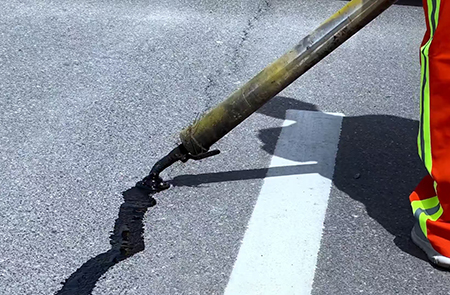
Before formal crack sealing operations, on-site inspection, the test of equipment and material verification shall be completed to eliminate construction risks at the source and lay a solid foundation for subsequent procedures. First, conduct a comprehensive inspection of cracks in terms of width, depth and distribution pattern, distinguish fine hairline cracks, conventional through cracks and aged irregular wide cracks, and formulate targeted construction plans accordingly. Second, inspect the operating status of specialized machinery including crack sealing machines, crack router machines, high-pressure blowers and heating equipment to guarantee stable equipment performance. Finally, verify the quality of asphalt crack sealant to ensure the materials comply with road maintenance standards, adapt to local climatic conditions, and deliver reliable bonding, waterproofing and high/low temperature resistance performance in follow-up construction.
Cleaning cracks after clearing loose and unstable fragments acts as a critical pre-process determining crack sealing quality. Its core objective is to fully eliminate impurities inside and around cracks, achieve tight bonding between crack sealant and pavement base material, and prevent hollowing, detachment and water seepage issues.
The construction mainly adopts the mechanical cleaning and is supplemented by manual work. crack router machines and blowers are used to comprehensively clear dust, weeds, debris and other contaminants accumulated inside cracks. For dead corners and micro crevices inaccessible to machinery, fine manual cleaning is conducted to ensure the interior of cracks is clean, dry, free of debris and oil stains. After cleaning, keep the cracks for inspection to confirm bare and clean base material without residual impurities.
The fluidity and adhesion of asphalt crack sealant directly determine crack sealing quality. Professional equipment shall be applied for precise temperature-controlled melting to avoid material aging caused by excessive heat or insufficient fluidity under low temperatures.
Put qualified asphalt crack sealant into dedicated heating and melting equipment. For products of different models, heat up at a constant speed and stir under constant temperature in accordance with product technical standards, with melting temperature strictly controlled to ensure fully melted, evenly textured and stably fluid crack sealant. Precise temperature control not only allows smooth filling of micro crevices, but also preserves the material’s inherent high elasticity, strong adhesion and temperature resistance, supporting the maintenance performance of crack resistance in winter and anti-flow in summer. Overheating that degrades material performance and inadequate melting under low temperatures reducing filling compactness shall be avoided throughout the whole process.
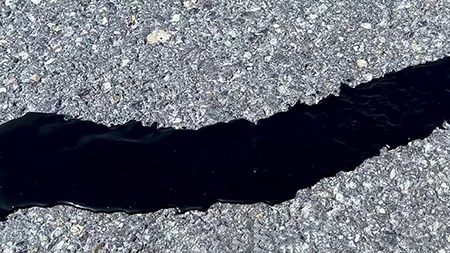
Start constantly filling operation with the crack sealing machine once the crack sealant reaches qualified melting status and crack are dry and clean. During construction, strictly control the speed and discharge volume of the crack sealing machine to maintain continuous and even casting, preventing material cutoff, overflow and uneven filling.
Adopt corresponding filling thickness and height for cracks of different sizes, following the general construction principle of full compaction and flat surface to guarantee completely filled slots free of voids and air bubbles. For extra-wide cracks, conduct layered filling and compaction to ensure full penetration and adhesion of crack sealant to slot walls. After curing, the integral structure becomes uniform and stable, fundamentally improving the sealing performance and integrity of repaired pavement cracks.
Traffic shall not be reopened immediately after crack sealing and filling. Sufficient static curing time at ambient temperature must be reserved for full solidification and forming of materials based on ambient temperature and crack sealant specifications.
Upon the completion of curing, on-site staff should inspect construction quality, checking that the surface of cured sealant is flat and compact without bulges, cracks or stickiness. Confirm the colloid will not adhere to vehicle tires or pavement gravel, and the repaired area meets all safety standards for traffic passage before officially reopening roads and restoring normal traffic flow.
For related product information, see our asphalt emulsifier products.